 biocomma
Introduction
Propionic acid and its sodium and calcium salts have bacteriostaticeffects, effectively preventing mold growth. It’s frequently used as apreservative and antifungal agent in food products. Biocomma hasestablished a simplified method that significantly reduces interferenceto ensure good recovery for the detection of propionic acid in varioussamples.

Experiment
Preparation
Weigh 5.0 g sample into a 50 mL centrifuge tube. Add 20 mL of waterand 0.5 mL of 1.0 mol/L phosphoric acid solution. Vortex for 2 min andextract by ultrasonic treatment for 10 min. Adjust the pH to 2.8~3.1 with1.0 mol/L phosphoric acid. Dilute to 50 mL with water. Shake to mix welland centrifuge at 8000 r/min for 5 min. Pipette 5 mL of supernatant to aclean tube. The sample is ready for purification.
Purification (Copure® HLB Cartridges, 500 mg/ 6 mL)
Activation: activated the cartridge by 5 mL of methanol, then 5 mL of water.
Loading: add prepared sample to the activated cartridge.
Washing: add 5 mL of 10% methanol-water solution, then drain the cartridge.
Elution: add 5 mL of 50 % methanol-water solution and collect theeluate. After filter by 0.22 μm nylon membrane, the sample is ready forLC-MS/MS analysis.
Instrumental Conditions
Instrument: liquid chromatograph, ThermoFisher U3000
Chromatographic column: Agilent ZORBAX SB-C18 (4.6 mm×250 mm,5 μm)
Mobile phase A: 1.5 g of diammonium hydrogen phosphate solution(adjust pH to about 3.0 by 1.0 mol/L phosphoric acid solution)
Mobile phase B: 50 % methanol-water solution
Flow rate: 1.0 mL/min
Column temperature: 25 ℃
Injection volume: 20 μL
Detector: UV detector
Detection wavelength: 214 nm
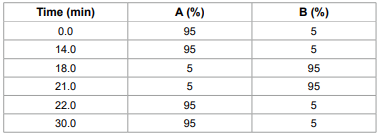
Table 1. Gradient Elution Program
Results
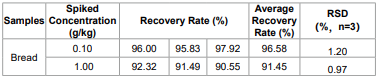
Table 2. Spiked Recovery Rates
Ordering Information
