biocomma
Introduction
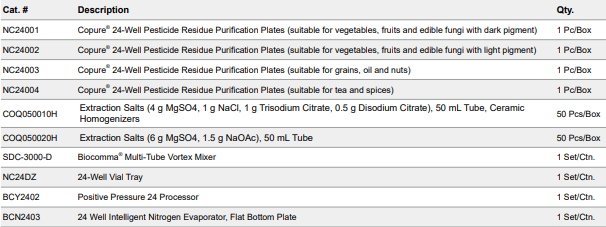
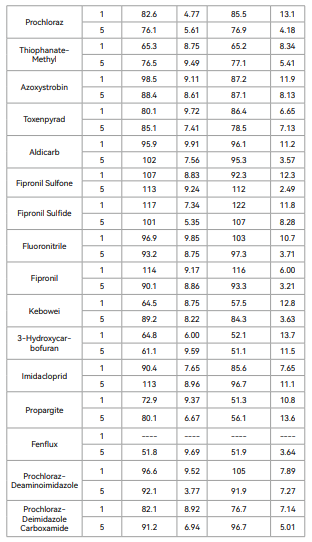
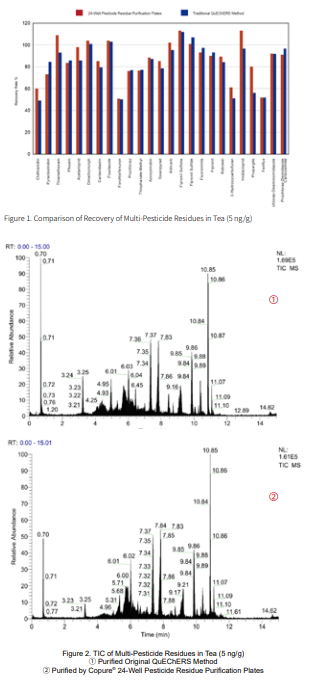
QuEChERS is widely used to detect pesticide residuesin plant-based foods. Biocomma introduces the Copure®24-Well Pesticide Residue Purification Plates enablingrapid, high-throughput analysis with Biocomma® PositivePressure 24 Processor system and sample vial tray. Nosyringe filtration is required prior to LC-MS/MS analysis.Biocomma established a high-throughput LC-MS/MS method with simplified operation and better resultstability for detecting 25 pesticide residues in tea. Therecoveries were 50-120% with CV values below 10% atboth 1 ng/g and 5 ng/g concentrations, which is close totraditional QuEChERS methods for your reference.

Experiment
Extraction (Copure® QuEChERS, Cat. #:COQ050020H)
Weigh 2.0 g of ground sample into a 50 mL centrifugetube. Add 10 mL of water, vortex mix, and let standfor 30 min. Add 15 mL of acetonitrile (1% acetic acid)and vortex for 5 min. Then add a pack of QuEChERSextraction salt and shake vigorously for 1 min. Vortex for5 min, then centrifuge at 5000 r/min for 5 min. The upperacetonitrile layer is ready for purification.
Purification (Copure ® 24-Well Pesticide ResiduePurification Plates, Cat. #: NC24004)
Place the 24-well purification plate on a Biocomma® 24-Well Vial Tray. Add 2 mL of prepared sample. Placethe purification plate and vial tray on the Biocomma®Positive Pressure 24 Processor. Turn on the gas. Makesure the wells of purification plate are positioned directlyunder the gas vent. Adjust the gas flow until all thesample filter into the sample vials. Screw on the capsand the sample is ready for analysis.
Instrument Conditions
1.Chromatography Conditions
Equipment: UPLC-MS/MS (Thermo Scientific TSQEndura)
Chromatographic column: Commasil ® BEH T-C18(100*2.1 mm,3 μm)
Mobile phase: A: Water (0.1% formic acid), B: MethanolFlow rate: 0.4 mL/min
Injection volume: 5 µL
Column temperature: 30 ℃
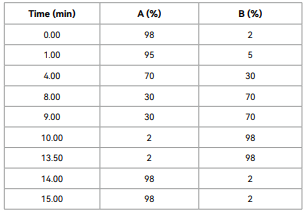
Table 1. Gradient Elution Program
2.Mass Spectrometry Conditions
source of ion: HESI
Electrospray voltage: 3500V
Sheath gas pressure: 40 Arb
Auxiliary air pressure: 1 Arb
Ion transfer tube: 380 ℃
Atomization temperature: 350 ℃
Results
Table 2. Experimental Results of Spiked Recovery

Ordering Information