biocomma
Introduction
Deoxynivalenol (DON) is a trichothecene compound widelypresent in wheat and its derivatives. Once ingested throughcontaminated agricultural products, DON leads to symptomsof poisoning, including vomiting, posing a significant threat tohuman health.
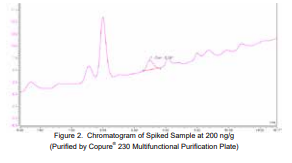
Biocomma established a high-throughput LC method usingCopure® 230 Multifunctional Purification Plate for detectionof DON in wheat flour with good recovery and stability foryour reference. The recoveries were 90-110%, and CV valuebetween wells was less than 5% at both 200 ng/g and 400 ng/gconcentrations.
Experiment
Extraction
Weigh 2 g of sample into a 50 mL centrifuge tube. Add 20 mLof acetonitrile-water solution (9:1) and vortex for 15 min to mixwell. Centrifuge at 6000 r/min for 5 min. The supernatant isready for purification.
Purification (Copure® 230 Multifunctional PurificationPlate)
Place a 24 well purification plate on a 24 well collection plate.Add 6 mL of supernatant to the purification plate. Place the 24well purification plate and the collection plate on the Biocomma®Positive Pressure 24 Processor. Turn on the gas. Make surethe wells of purification plate are positioned directly underthe gas vent. Adjust the gas flow until all the sample filter intothe collection plate. Pipette 4 mL of sample to a clean tube.Evaporate sample to dryness at 40 ℃ and redissolve by 1 mLof initial mobile phase. Vortex for 30 seconds to dissolve theresidue. After filter by 0.22 μm microporous membrane, thesample is ready for analysis.
Instrument Conditions
Equipment: UltiMate 3000 (Thermo Fisher Scientific) with DADdetector.
Chromatographic column: Agilent ZORBAX C18 (4.6 mm×250mm,5 μm)
Mobile phase: A: Methanol, B: Deionized water
Flow rate: 0.8 mL/min
Column temperature: 35 ℃
Injection volume: 50.0 μL
Detection wavelength: 218 nm
Table 1. Gradient Elution Program


Results
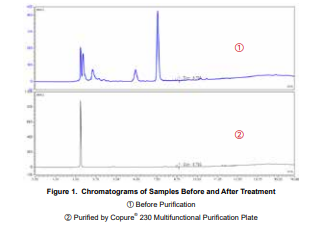
Based on Figure 1, less miscellaneous peaks showingthe impurities are obviously absorbed by Copure® 230Multifunctional Purification Plate. There are no interferencepeaks next to the target peak, so the quantification is moreaccurate.
Table 2. Deoxynivalenol Spike Recovery in Wheat Flour

Based on Table 2, the recovery rates of deoxynivalenol in the24 wells are all between 90-110%, and the CV value of therecovery rate between wells is less than 5%, which meet thestandard of the experimental requirements
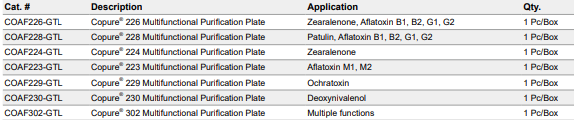
Ordering Information