biocomma
Introduction
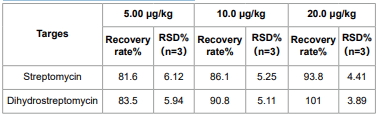
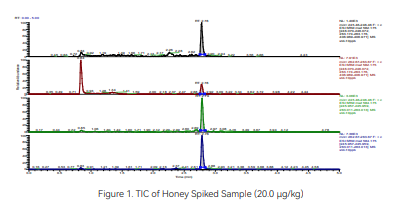
Streptomycin and dihydrostreptomycin belong toaminoglycoside antibiotics, which have antibacterial activityagainst Gram-negative bacteria to prevent from variousanimal diseases. In the beekeeping industry, streptomycinand dihydrostreptomycin effectively treat bee rot and maggotdisease, but due to unscientific management and use, theyoften cause residues in bee products. Biocomma optimizedsample preparation of streptomycin and dihydrostreptomycinresidues in honey to establish a SPE-UPLC-MS/MS methodwith good recovery and stability for your reference.
Experiment
Extraction
Accurately weigh 5 g of the sample into a 50 mL centrifugetube. Add 10 mL of buffer solution (2% trichloroacetic acid inphosphate buffer). Vortex for 1 min. Then, extract by ultrasonictreatment for 10 min. Add 10 mL of buffer solution and diluteto 25 mL. Vortex for 1 min and extract by ultrasonic treatmentfor 5 min. Centrifuge at 10,000 r/min for 5 min. The sample isready for purification.
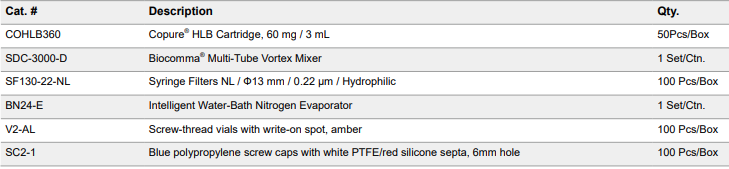
Purification (Copure® HLB Cartridge, 60 mg/ 3 mL)
Activation: activate the Copure® HLB Cartridge by 3 mL ofmethanol, then 3 mL of water.
Loading: add 5 mL of the prepared solution to the activatedcartridge.
Washing: wash the cartridge twice by 2 mL of water, and drainthe cartridge.
Elution: add 1 mL of formic acid-acetonitrile-water (2:10:88,v:v:v). Collect the eluate and dilute to 2 mL by 1 mL of 2%ammoniated acetonitrile. After vortex and filter by membrane,the sample is ready for analysis.
Preparation of Standard Curve Solution
Add an appropriate amount of mixed standard intermediatesolution to blank sample in turn. Follow the steps of sampleextraction and purification to prepare the standard curves withconcentrations of 2.5 ng/mL, 5 ng/mL, 10 ng/mL, 20 ng/mL, 50ng/mL, and 100 ng/mL.
Instrumental Conditions
1.Chromatographic conditions
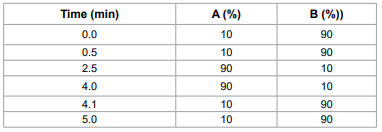
Chromatographic column: Hilic (2.1 mm×100 mm, 2.7 μm)Mobile phase A: 5 mmol/L ammonium acetate (containing 0.3%formic acid)
Mobile phase B: acetonitrile (containing 0.3% formic acid)Flow rates: 0.3 mL/min
Column temperature: 35℃
Injection volume: 10 μL
Table 1. Gradient Elution Program
2.Mass spectrometry conditions
Ion source: HESI
Electrospray voltage: 3500 V
Sheath gas pressure: 40 arb
Auxiliary gas pressure: 10 arb
Ion transfer tube: 350 ℃
Auxiliary gas temperature: 375 ℃
Table 2. Targes Characteristic Ions (*Quantifier Ion)

Results
Table 3. Spike Recovery Results
Ordering Information