biocomma
Introduction
Zearalenone, a non-steroidal mycotoxin from Fusarium fungus,is commonly found in contaminated grains (wheat, corn, oats,barley, etc.). It’s a major global crop contaminant, leadingto adverse effects such as tumors, estrogen presence, andimmune suppression in livestock and poultry that consumecontaminated feed, and then poses a risk to human health.Biocomma established an LC method to detect zearalenonein corn flour using Copure® 224 Multifunctional PurificationColumn. At 8 ng/g and 16 ng/g concentratios, recoveries were90-100% with RSD below 10%. This rapid method outperformscompetitors, ensuring high recovery, efficient decolorization,and impurity removal. It’s a valuable reference for zearalenonedetection in corn flour, applicable to grains, wine, soy sauce,vinegar, soybean, rapeseed, and edible vegetable oil.

Experiment
Preparation
Weigh 5 g of sample into a clean tube. Add 1 g of sodiumchloride and 20 mL of acetonitrile-water solution (9+1). Shaketo mix well. Vortex for 15 min, and centrifuge at 6000 r/min for5 min. The supernatant is ready for purification.
Purification (Copure® 224 Multifunctional PurificationColumn)
Add 10 mL of prepared sample to a glass tube. Insert therubber head of the purification column into the tube, and pushto the bottom. Pipette 5 mL of the purified sample to a samplevial or EP tube. Evaporate sample to dryness and redissolve by1 mL of initial mobile phase. Vortex for 30 seconds to dissolvethe residue. After filter by 0.22 μm microporous membrane, thesample is ready for analysis.
Instrument Conditions
Equipment: UltiMate 3000(Thermo Fisher Scientific) with FLDdetector.
Chromatographic column: Agilent ZORBAX C18 (4.6 mm×250mm, 5 μm)
Mobile phase: A: Acetonitrile, B: Deionized water, C: MethanolFlow rate: 1.0 mL/min
Column temperature: room temperature
Injection volume: 50.0 μL
Detection wavelength: excitation wavelength 274 nm, emissionwavelength 440 nm
Detector: FLD
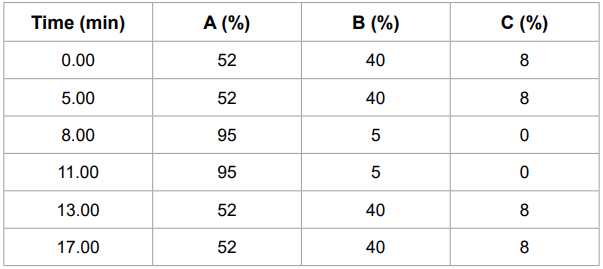
Table 1. Gradient Elution Program
Results
Table 2. Zearalenone Spike Recovery in Corn Flour
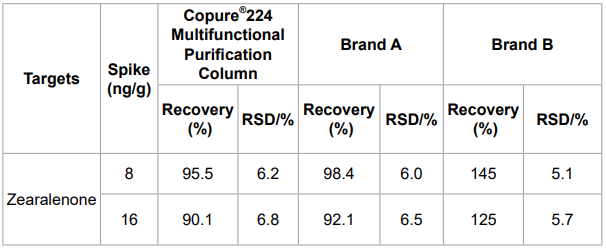
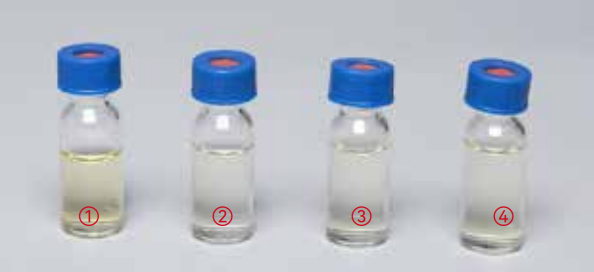
Figure 1. Decolorization Effect by Different Brands ofMultifunctional Purification Columns
① Corn flour Sample Before Purification
② Purified by Copure® 224 Multifunctional Purification Column
③ Purified by Brand A
④ Purified by Brand B
Based on Figure 1, the pigments are obviously absorbedby Copure® 224 Multifunctional Purification Column. Thedecolorization ability is similar to Brand A and B.
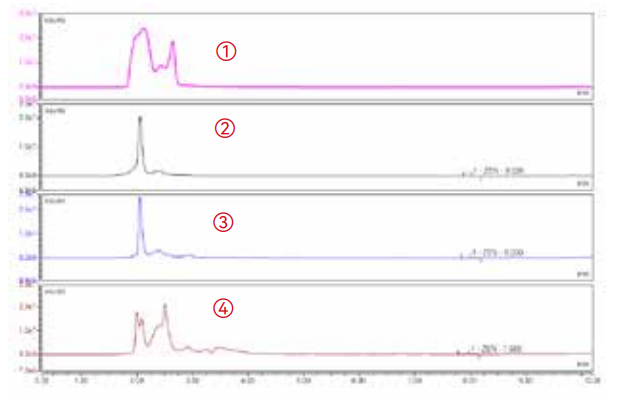
Figure 2. Chromatograms of Spiked Samples Purified by Different Brands
① Corn flour Sample Before Purification
② Purified by Copure® 224 Multifunctional Purification Column
③ Purified by Brand A
④ Purified by Brand B
Based on Figure 2, the interference of impurities in sample② are obviously absorbed, therefore miscellaneous peaksare fewer in the TIC chromatogram. The purification effect ofCopure® 224 Multifunctional Purification Column is similar toBrand A and better than Brand B.
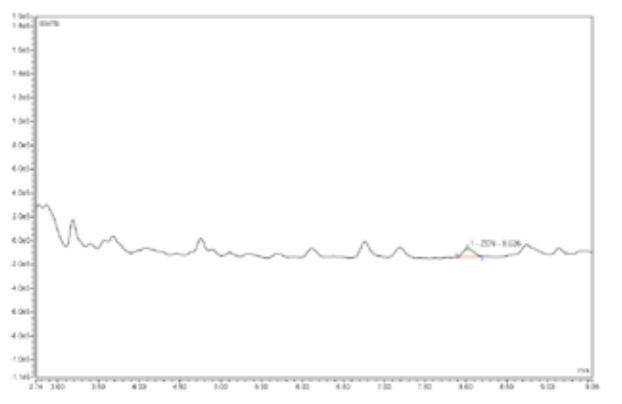
Figure 3. Chromatogram of Spiked Sample (8 ng/g) purified by Copure® 224 MultifunctionalPurification Column
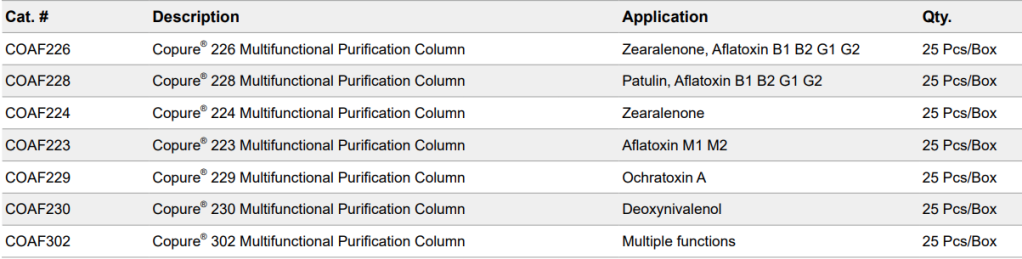
Ordering Information