 biocomma
Introduction
Synthetic colorants often rely on chemicals like benzene,toluene, and naphthalene as key raw materials. They’refavored for their low cost, vibrant colors, strong pigmentation,and wide range of shades. However, excessive consumptioncan pose health risks. Biocomma established a HPLC methodwith simplified operation and good recovery to detect syntheticcolorants in foods for your reference.
Experiment
Preparation
Prepare ethanol-ammonia solution: add 700 mL of ethanol and4 mL of ammonia. Dilute to 1 L by water.
Extraction of liquid and partial solid samples (e.g., beverages, juice, jellies, etc.)
Weigh 2 g of the sample into a 50 mL centrifuge tube. Add 25mL of ethanol-ammonia solution, and vortex for 5 min. Extractby ultrasonic treatment for 15 min at 50 °C, and centrifuge at8000 rpm for 5 min. Transfer the supernatant into a clean 50mL centrifuge tube. Add 15 mL of the ethanol-ammonia solutionto the remaining sample. Repeat the extraction procedures.Combine the supernatants and dilute to 50 mL. Pipette 10mL of supernatant to a clean tube and concentrate to 2 mL at50°C. Add 10 mL of 5% aqueous methanol solution and mixwell. The sample is ready for purification.
Extraction of oily samples (e.g., dessert, chicken wings,potato chips, etc.)
Weigh 2 g of the sample into a 50 mL centrifuge tube. Add 20mL of petroleum ether, and shake to mix well. Vortex for 10min. Centrifuge at 8000 rpm for 5 min. Discard the supernatantto remove the petroleum ether solvent. Add 25 mL of ethanolammonia solution and vortex for 1 min. ultrasonicate at 50 ℃for 15 min, and then centrifuge at 8000 rpm for 5 min. Extractby ultrasonic treatment for 15 min at 50 °C, and centrifuge at8000 rpm for 5 min. Transfer the supernatant into a clean 50mL centrifuge tube. Add 15 mL of the ethanol-ammonia solutionto the remaining sample. Repeat the extraction procedures.Combine the supernatants and dilute to 50 mL. Pipette 10mL of supernatant to a clean tube and concentrate to 2 mL at50°C. Add 10 mL of 5% aqueous methanol solution and mixwell. The sample is ready for purification.
Purification (Copure® PWAX Cartridges, 150 mg/ 6 mL)
Activation: activated the cartridge by 6 mL of methanol, then 6mL of water.
Loading: add prepared sample to the activated cartridge.
Washing: add 6 mL of water, then 6 mL of methanol. Drain thecartridge.
Elution: add 6 mL of 5% ammoniated methanol solution andcollect the eluate. Evaporate to about 0.3 mL at 45 °C. Diluteto 2 mL with 0.02 mmol/L ammonium acetate (pH=9.0). Vortexto mix well. After filter by PTFE membrane, the sample is readyfor LC-MS/MS analysis.
Instrumental Conditions
Instrument: liquid chromatograph, Thermo Fisher U3000
Chromatographic column: Agilent ZORBAX SB-C18 (4.6mm×250 mm, 5 μm)
Mobile phase: A: 0.02mol/L ammonium acetate solution, B:methanol
Flow rate: 1.0 mL/min
Column temperature: 30 ℃
Injection volume: 10 μL
Detector: UV detector
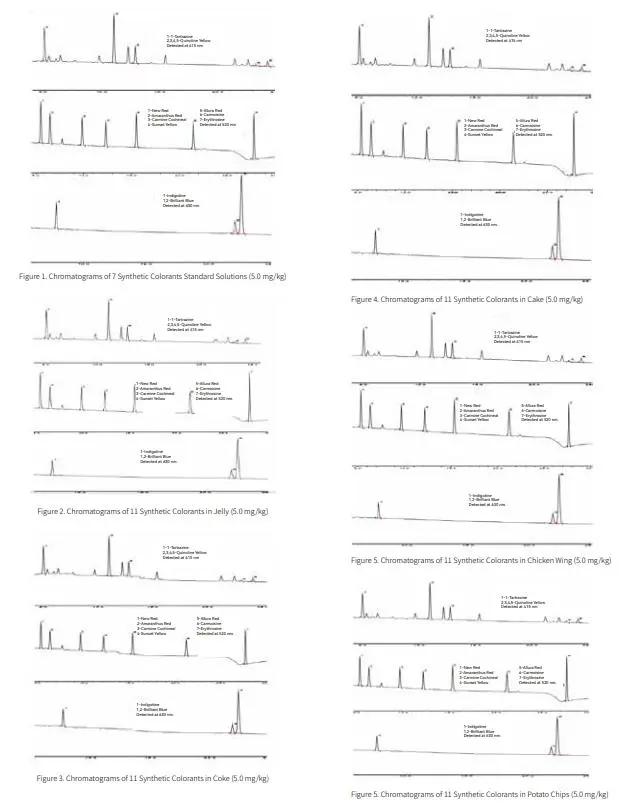
Detector wavelength range: 400~800 nm. (Tartrazine: 415 nm.New red, carmine cochineal, amaranthus red, sunset yellow,allura red and erythrosine: 520 nm. Brilliant blue: 630 nm.)
Table 1. Gradient Elution Program

Results
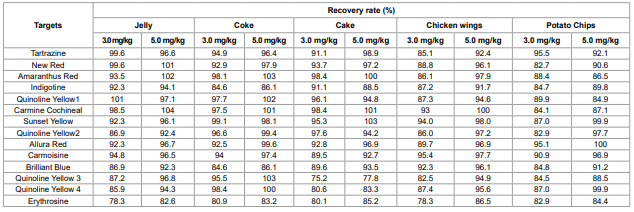
Table 2. Spiked Recovery Rates
Ordering Information
